Sweepstakes Casino Legal States: The Complete 2026 Guide
Which states ban sweepstakes casinos in 2026? All 50 states checked against official sources: ten bans, state lawsuits, pending bills and where you can still play.

Sweepstakes casinos are no longer legal everywhere. As of November 2026, 10 states ban them by their own law, 2 more have regulators treating them as illegal, and the bans are arriving faster every session. All ten of those state laws were passed in 2025 or 2026.
That is the call. If you play at sweepstakes casinos, the state you live in now matters more than which casino you pick. Below is where every state stands, checked against each state's own legislature, regulator or attorney general, not against other review sites.
The Short Version
- Banned by state law (10): California, Connecticut, Indiana, Louisiana, Maine, Montana, New Jersey, New York, Oklahoma (since November 1, 2026) and Tennessee.
- Treated as illegal by the state regulator (2): Michigan and Washington.
- Bills filed, not law yet (6): Pennsylvania, Maryland, Virginia, Minnesota, Massachusetts and Wyoming.
- Enforcement without a ban: Kentucky, Florida and Arkansas are suing operators in court, and Illinois, Arizona and Maryland have sent cease-and-desist letters.
- No specific law: every other state, including Texas, Georgia, Ohio and North Carolina.
Even where the law is silent, the casinos decide for themselves. Only 15 states are accepted by every one of the 49 casinos we review. Nevada is the clearest case: it has no sweepstakes-specific ban, yet not one of them takes Nevada players.
How Sweepstakes Casinos Claim to Be Legal
Most US gambling law rests on three elements. If an activity has all three, it is gambling:
- Prize: something of value can be won.
- Chance: the outcome is random.
- Consideration: you pay to take part.
The US Supreme Court used this test in FCC v. American Broadcasting Co. (1954), and state laws are built the same way. Sweepstakes casinos keep the prize and the chance, and attack the third element. They sell Gold Coins for play, give Sweeps Coins away as a bonus, and always offer a free way to get Sweeps Coins: daily logins, sign-up bonuses and mail-in requests. No purchase necessary, so no consideration, so no gambling. That is the argument.
It held for years because no state law named the model. That has changed. The new laws don't argue about consideration at all: they define a "dual-currency" game that simulates casino play and ban it outright. California, New York, Maine and Louisiana all use that approach. Once a state writes that definition into law, the free-entry argument stops working there. Our guide to how sweepstakes casinos work covers the two-coin model in more detail.
The Bans, in Order
The pace is the story. Montana moved first in 2025, and nine states followed within eighteen months.
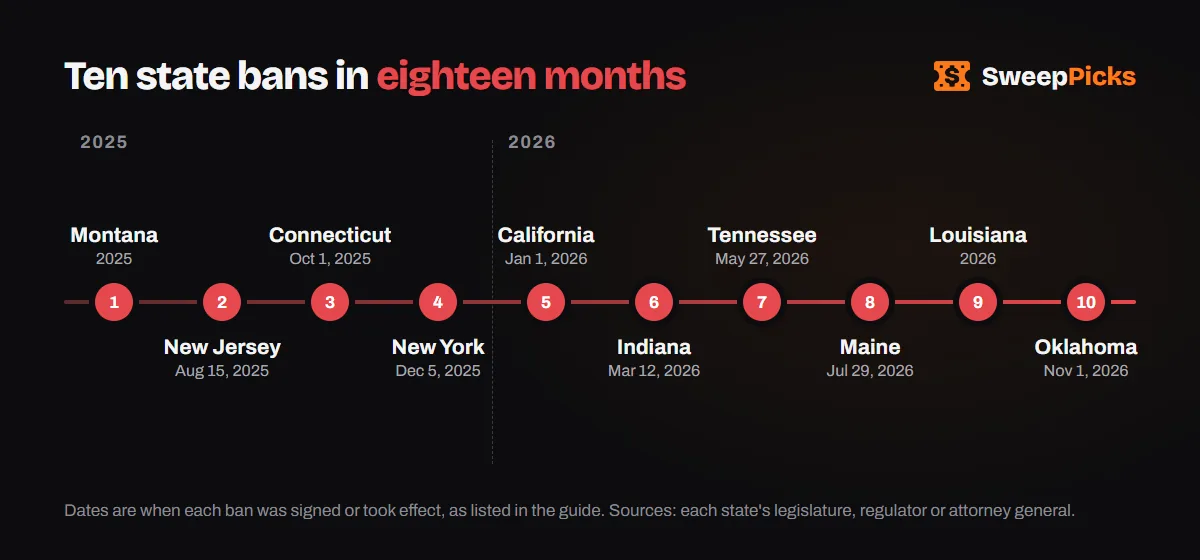
Montana, 2025. SB 555 revised the state's online gambling laws and made one offense a felony. Montana's Gambling Control Division says the only legal online gambling in the state is nonprofit raffles.
New Jersey, August 15, 2025. P.L. 2025, c.128 (A5447) prohibits sweepstakes that use a dual-currency system. Running an online gambling resort now carries a penalty of $50,000 to $100,000.
Connecticut, October 1, 2025. Public Act 25-112 bars anyone without an online casino license from running a sweepstakes that allows real or simulated online casino gaming. A violation is a class A misdemeanor and an unfair trade practice.
New York, December 5, 2025. S5935A took effect immediately, with fines of $10,000 to $100,000 per violation. It reaches beyond operators to payment processors, platform providers and media affiliates. In 2026 the New York Attorney General secured $8 million from a leading sweepstakes operator.
California, January 1, 2026. AB 831, signed on October 11, 2025, makes operating or offering an online sweepstakes game a crime, with fines of $1,000 to $25,000 and up to a year in county jail. It also bars payment processors and platform providers from knowingly supporting these games. This is the biggest market to close, and by a distance.
Indiana, March 12, 2026. HB 1052 (Public Law 153) lets the Indiana Gaming Commission fine anyone who knowingly runs an internet sweepstakes game in the state $100,000.
Tennessee, May 27, 2026. SB 2136 (Public Chapter 1117) makes operating or promoting online sweepstakes games unlawful and a violation of the Tennessee Consumer Protection Act. It came five months after the Attorney General sent cease-and-desist letters to almost forty sweepstakes casinos.
Maine, July 29, 2026. LD 2007 makes operating, promoting or supporting an online dual-currency casino-style game a civil violation, with fines of $10,000 to $100,000.
Louisiana, 2026. HB 883, enacted as Act 182, treats any online dual-currency game that simulates gambling as gambling by computer, and lets the attorney general send cease-and-desist notices to platforms and payment processors. The Gaming Control Board had already sent more than 40 cease-and-desist letters to offshore and sweepstakes operators in its 2024 to 2025 fiscal year.
Oklahoma, November 1, 2026. SB 1589 makes running or promoting dual-currency sweepstakes casinos a felony. It is now in force. Our Oklahoma report covers what the law says and who it reaches.
Look at who signed these. Several are states that run legal online casinos (New Jersey, Connecticut, Michigan through its regulator) or protect a strong land-based industry. To them, a sweepstakes casino is an unlicensed competitor that pays no gaming tax. Expect states with a licensed online casino market to keep leading this.
Regulators That Didn't Wait for a Law
Two states treat sweepstakes casinos as illegal under laws they already had.
Michigan. The Michigan Gaming Control Board calls these sweepstakes unlicensed online lotteries or raffles, and keeps sending cease-and-desist letters to unlicensed operators, including sweepstakes-style sites. Its October 2026 round went to 33 offshore operators. Running a gambling business without a Board license is a felony in Michigan.
Washington. The Washington State Gambling Commission says online sweepstakes are not legal in the state, and online gambling is a class C felony. Washington has been the hardest state in this category for years, and almost every operator excludes it.
Other states are pushing without a ban, and since June 2026 the push has moved into court. Three Attorneys General have now sued VGW, the biggest operator in the category. That is the new front: a lawsuit needs no new law, only a judge who agrees the existing gambling law already covers the model.
- Kentucky. On June 17, 2026 the Attorney General sued VGW, the operator of Chumba Casino and LuckyLand Casino, alleging its sweepstakes casinos are illegal real-money gambling.
- Florida. On August 19, 2026 the Attorney General sued Stake and VGW, along with their payment processors, alleging their sweepstakes casinos are illegal gambling under Florida law. The state wants both barred from doing business in Florida.
- Arkansas. On November 4, 2026 the Attorney General sued VGW under the Deceptive Trade Practices Act, seeking restitution, penalties, taxes and an injunction.
- Illinois. The Illinois Gaming Board, with the Attorney General, has sent more than 60 cease-and-desist letters to operators it believes run illegal online casino or sweepstakes platforms, citing state criminal law.
- Arizona. The Department of Gaming notes that "sweepstakes" is not even a defined term in Arizona law, and has sent cease-and-desist orders to operators it considers unauthorized gambling, Stake.us among them.
- Maryland. The Lottery and Gaming Control Agency has sent cease-and-desist letters to sweepstakes operators, including VGW in March 2025 and High 5 Casino.
None of the lawsuits has been decided. They are the states' allegations, and the operators are fighting them.
The Watch List
These states have bills or drafts that would ban sweepstakes casinos. None has become law yet.
- Maryland is the closest. HB 295 passed the House 105 to 24 on March 20, 2026, then stalled in the Senate. With the House on record and the regulator already sending letters, Maryland is my pick for the next ban.
- Pennsylvania. HB 2801, a wider gaming bill, includes a sweepstakes ban. It expires with the 2025 to 2026 session, so a ban would have to be filed again in 2027. The Gaming Control Board told lawmakers in 2025 that it considers sweepstakes casinos illegal online gambling.
- Virginia. HB 161 and SB 118 would have licensed online casinos and made unlicensed sweepstakes illegal. Neither passed in 2026. A third bill, SB 579, began as a straight ban, was cut back to a study by a Virginia Lottery Board work group, and carries over to the 2027 session.
- Minnesota. HF 4410 and SF 4474 would ban online sweepstakes games and the businesses that support them. Neither passed in 2026.
- Massachusetts. H.4431 would ban online sweepstakes games as part of licensing online casinos. It has sat in committee since August 2025. Massachusetts has also asked for federal oversight of the category.
- Wyoming. Draft bill 27LSO-0098 would make operating an online casino or sweepstakes game professional gambling, a felony, while leaving players themselves out. The Select Committee on Gaming took it up in October 2026, ahead of the session that starts in January.
- Washington, D.C. B26-0656 would license online casinos and ban dual-currency sweepstakes games, with fines of up to $100,000 per violation. It was still in committee in November 2026, and the Council period ends on January 2, 2027.
The pattern is consistent: a sweepstakes ban increasingly travels with a bill to license real-money online casinos. Where a state is ready to license iGaming, the sweepstakes model is the first thing it closes.
All 50 States
The table below is built from the same data as our state pages, so it always matches them. "Casinos we review that accept it" counts how many of our reviewed casinos leave the state off their own excluded list. Click a state for its full page: the law, the casinos open to you and the ones that aren't.
| State | Status | Law or action | Casinos we review that accept it |
|---|---|---|---|
| California | Banned by state law | AB 831, in force Jan 1, 2026 | 9 of 49 |
| Connecticut | Banned by state law | Public Act 25-112, Oct 1, 2025 | 3 of 49 |
| Indiana | Banned by state law | HB 1052 (Public Law 153), 2026 | 9 of 49 |
| Louisiana | Banned by state law | HB 883 (Act 182), 2026 | 4 of 49 |
| Maine | Banned by state law | LD 2007, in force Jul 29, 2026 | 9 of 49 |
| Montana | Banned by state law | SB 555, 2025 | 3 of 49 |
| New Jersey | Banned by state law | P.L. 2025, c.128, Aug 15, 2025 | 3 of 49 |
| New York | Banned by state law | S5935A (Ch. 605), Dec 5, 2025 | 8 of 49 |
| Oklahoma | Banned by state law | SB 1589, from Nov 1, 2026 | 0 of 49 |
| Tennessee | Banned by state law | SB 2136 (Pub. Ch. 1117), May 27, 2026 | 3 of 49 |
| Michigan | Illegal per state regulator | Gaming Control Board cease-and-desist letters | 3 of 49 |
| Washington | Illegal per state regulator | Gambling Commission: not legal | 3 of 49 |
| Arizona | Other state action | Department of Gaming cease-and-desist orders | 47 of 49 |
| Arkansas | Other state action | Attorney General lawsuit against VGW, Nov 2026 | 49 of 49 |
| Florida | Other state action | Attorney General lawsuits against Stake and VGW, Aug 2026 | 47 of 49 |
| Idaho | Other state action | Constitution bans casino gambling | 3 of 49 |
| Illinois | Other state action | Gaming Board cease-and-desist letters | 37 of 49 |
| Iowa | Other state action | SF 2289: regulator can order illegal sweepstakes to stop | 41 of 49 |
| Kentucky | Other state action | Attorney General lawsuit against VGW, Jun 2026 | 38 of 49 |
| Maryland | Bill pending or failed | HB 295 passed House, not law | 26 of 49 |
| Massachusetts | Bill pending or failed | H.4431 in committee | 49 of 49 |
| Minnesota | Bill pending or failed | HF 4410 / SF 4474 not passed | 47 of 49 |
| Pennsylvania | Bill pending or failed | HB 2801 pending | 41 of 49 |
| Virginia | Bill pending or failed | Ban bills not passed, SB 579 to 2027 | 49 of 49 |
| Wyoming | Bill pending or failed | Draft 27LSO-0098 for 2027 | 43 of 49 |
| Alabama | No specific law | None found | 46 of 49 |
| Alaska | No specific law | None found | 49 of 49 |
| Colorado | No specific law | None found | 49 of 49 |
| Delaware | No specific law | None found | 16 of 49 |
| Georgia | No specific law | None found | 46 of 49 |
| Hawaii | No specific law | None found | 46 of 49 |
| Kansas | No specific law | None found | 49 of 49 |
| Mississippi | No specific law | None found | 47 of 49 |
| Missouri | No specific law | None found | 49 of 49 |
| Nebraska | No specific law | None found | 47 of 49 |
| Nevada | No specific law | None found | 2 of 49 |
| New Hampshire | No specific law | None found | 49 of 49 |
| New Mexico | No specific law | None found | 49 of 49 |
| North Carolina | No specific law | None found | 49 of 49 |
| North Dakota | No specific law | None found | 47 of 49 |
| Ohio | No specific law | None found | 46 of 49 |
| Oregon | No specific law | None found | 49 of 49 |
| Rhode Island | No specific law | None found | 38 of 49 |
| South Carolina | No specific law | None found | 49 of 49 |
| South Dakota | No specific law | None found | 49 of 49 |
| Texas | No specific law | None found | 49 of 49 |
| Utah | No specific law | None found | 46 of 49 |
| Vermont | No specific law | None found | 47 of 49 |
| West Virginia | No specific law | None found | 29 of 49 |
| Wisconsin | No specific law | None found | 49 of 49 |
Two things stand out. First, a casino's excluded-states list does not always keep up with the law: a few still list states where a ban is in force. Treat the law as the stronger signal. Second, "No specific law" does not mean "approved". It means no state law names the model yet. You can also see availability at a glance on our sweepstakes casino map.
Registration States: Regulated, Not Banned
A few states regulate sweepstakes promotions in general, which is a different thing from banning sweepstakes casinos:
- Florida: a game promotion with more than $5,000 in prizes must be filed with the Department of Agriculture and Consumer Services at least seven days before it starts, backed by a trust account or surety bond.
- New York: a game of chance with more than $5,000 in prizes must be registered with the Secretary of State and bonded for the full prize value. New York's 2025 ban on sweepstakes casinos sits on top of this.
- Rhode Island: a retail game of chance with more than $500 in prizes must be registered with the Secretary of State.
Florida shows the difference: by statute it regulates the promotion, not the model, and nearly every casino we review accepts Florida players. Its Attorney General's lawsuit is the attempt to change that in court.
What This Means for You
- Check your state first. Find it in the table above or on our state pages. If your state bans these casinos, that settles it, whatever a casino's terms say.
- Then check the casino. Its excluded-states list is in its terms or sweepstakes rules. If it doesn't publish one, ask before you sign up.
- Don't use a VPN. Sweepstakes casino terms routinely forbid it, and a redemption from a banned location is the easiest one for a casino to refuse.
- Redeem what you hold before a ban starts. When New York's ban took effect, operators stopped selling coins there, according to the state's Attorney General. Don't leave a Sweeps Coin balance waiting on a deadline.
- You never have to buy. Every sweepstakes casino must offer a free way in. Our free Sweeps Coins, no deposit list ranks the sign-up coins in the states where they are available.
The Verdict
The gray zone is closing, and it's closing from the biggest states inward. California, New York and New Jersey are gone, and a growing list of states is treating the free-entry argument as a loophole rather than a defence. Where you still can play, the casinos themselves are often stricter than the law, which is why a state like Nevada is closed in practice without a sweepstakes ban.
For players, the practical rule is simple: the law in your state decides first, the casino's own terms second. We check both, and we update this guide and every state page when a law changes.
Sources
Every law and action above is taken from the state's own legislature, regulator or attorney general, checked in November 2026:
- California: AB 831
- Connecticut: Public Act 25-112
- Indiana: HB 1052
- Louisiana: Act 182 (HB 883), Gaming Control Board annual report
- Maine: LD 2007, Gambling Control Unit
- Montana: Gambling Control Division FAQ
- New Jersey: P.L. 2025, c.128
- New York: S5935A, Attorney General, game of chance registration
- Oklahoma: SB 1589
- Tennessee: SB 2136, Attorney General
- Michigan: Gaming Control Board
- Washington: State Gambling Commission
- Kentucky: Attorney General
- Florida: Attorney General
- Arkansas: Attorney General
- Illinois: Gaming Board cease-and-desist letters
- Arizona: Department of Gaming
- Maryland: HB 295, Lottery and Gaming
- Pennsylvania: HB 2801
- Virginia: SB 118, SB 579
- Minnesota: HF 4410
- Massachusetts: H.4431
- Wyoming: Select Committee on Gaming agenda
- Washington, D.C.: B26-0656
- Florida: section 849.094
- Rhode Island: game of chance filing
This guide is for information only and is not legal advice. Laws change; if you need advice for your situation, speak to a licensed attorney in your state. 18+ (21+ at some casinos). No purchase necessary. If gambling stops being fun, call 1-800-MY-RESET.
Sweepstakes Casino Legal States FAQ
- Which states have banned sweepstakes casinos?
- As of November 2026, ten states ban online sweepstakes casinos by their own law: California, Connecticut, Indiana, Louisiana, Maine, Montana, New Jersey, New York, Oklahoma (since November 1, 2026) and Tennessee. In Michigan and Washington, the state regulator treats them as illegal under existing gambling law.
- Are sweepstakes casinos legal in Texas and Florida?
- Neither state has a law aimed specifically at online sweepstakes casinos as of November 2026, and nearly every casino we review accepts players from both. Florida is pushing anyway: in August 2026 its Attorney General sued Stake and VGW, the operator of Chumba Casino, alleging their sweepstakes casinos are illegal gambling. That is a lawsuit, not a ruling. Florida also regulates sweepstakes promotions in general: one with more than $5,000 in prizes must be filed with the state seven days before it starts.
- Why are sweepstakes casinos legal in some states?
- Gambling needs three things: a prize, chance and consideration (paying to play). Sweepstakes casinos always offer a free way to get Sweeps Coins, which they argue removes consideration. States that disagree have started passing laws that name dual-currency sweepstakes casinos directly.
- Which states might ban sweepstakes casinos next?
- Bills were filed in Pennsylvania, Maryland, Virginia, Minnesota and Massachusetts, and Wyoming has a draft ban for its 2027 session. Maryland came closest: its House passed a ban 105 to 24 in March 2026, but the Senate did not act before the session ended.
- Which states are suing sweepstakes casinos?
- Three state Attorneys General have sued VGW, the operator of Chumba Casino: Kentucky in June 2026, Florida in August 2026 (which also sued Stake) and Arkansas in November 2026. None of these cases has been decided.
- If a casino still accepts my state, is it legal for me to play?
- Not necessarily. A casino's own list of excluded states can lag behind a new law. Check your state's law first, then the casino's terms, and contact the casino if the two disagree.
- Is there a federal law on sweepstakes casinos?
- No federal law addresses online sweepstakes casinos directly. The rules are set state by state, which is why the answer depends on where you live.